
It’s the hundredth ‘why’ of the day. ‘Why is the sky blue? Why do we sleep? Why, why, why?’ You’re exhausted, and the words slip out: ‘Because I said so.’ We’ve all done it. But every time we shut a question down, we quietly switch off the very thing that makes a child brilliant: curiosity.
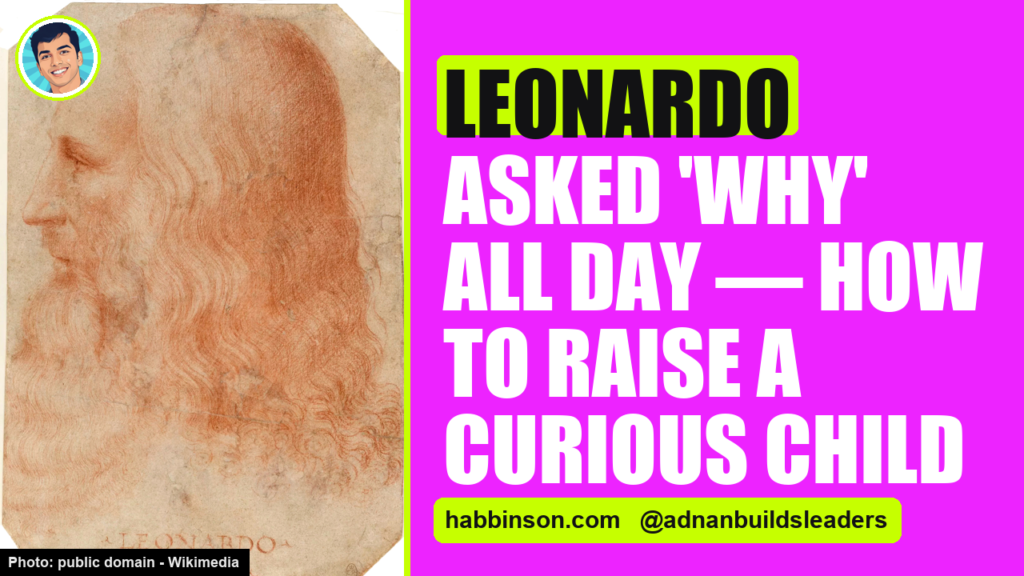
Consider the most curious mind in history. **Leonardo da Vinci** filled thousands of notebook pages with questions — why birds fly, how water swirls, what’s inside the human body. He had little formal schooling. His genius wasn’t a fancy education; it was a curiosity he never let anyone switch off. That same engine is humming inside your question-asking child.
Here’s the good news about curiosity in children: it’s not a nuisance to manage, it’s a strength to feed. Let’s look at why questions matter so much, and how to keep your child’s curiosity alive instead of accidentally killing it.
Why curiosity in children matters so much
Curiosity isn’t just cute — it’s rocket fuel for learning. Researchers have found that curious children simply learn more, because wanting to know an answer primes the brain to remember it. One study found that curiosity actually boosts memory: kids remember information far better when they were curious about it first.
Why is curiosity important for kids? Curiosity drives a child to explore, ask, and figure things out — the core of all real learning. Curious children enjoy school more, learn more deeply, and remember better, because interest primes the brain to hold on to information. Feeding curiosity today builds a lifelong, self-driven learner.
The Greater Good Science Center at Berkeley lists surprising benefits of curiosity — including higher academic achievement and a lasting love of learning. In one large study of thousands of children, the most curious kindergarteners scored higher in both reading and maths. Questions aren’t a distraction from learning. They are learning.
How we accidentally kill a child’s curiosity
Curiosity is fragile. It dies a little every time a child learns that questions are unwelcome. Most of us do it without meaning to — we’re tired, we’re busy, and ‘because I said so’ is faster than a real answer.
- Shutting questions down: ‘Stop asking so many questions.’ Message: your wondering annoys me.
- Always giving the instant answer: it ends the thinking before it starts.
- Punishing ‘wrong’ guesses: a child who fears being wrong stops exploring.
- Filling every minute: a packed schedule leaves no quiet space for wondering.
4 ways to feed your child’s curiosity
- Turn the question back: ‘Great question — what do YOU think?’ Let them guess before you answer. Thinking is the muscle.
- Say ‘let’s find out’: model curiosity. Look it up together, do a little experiment, ask someone who knows.
- Welcome ‘why’, don’t dread it: a simple ‘I love that you noticed that’ keeps the questions coming.
- Protect boredom and free play: wondering needs blank space. Don’t fill every minute.
Teachers who want curious classrooms do the same thing. Berkeley’s guide on cultivating curiosity stresses modelling wonder and rewarding questions, not just answers. At home, you are your child’s first and most important curiosity coach.
From curious kid to a child who stands out
Here’s the long game. The world is automating away rote memory and rewarding the people who ask the best questions, spot what others miss, and keep learning their whole lives. Curiosity is the root of creativity, problem-solving, and innovation — the exact traits that make a child stand out in any future.
Da Vinci’s questions built one of history’s greatest minds. Your child’s ‘whys’ are the same raw material. So the next time the hundredth question comes, try not to dread it. Lean in. Our guides on helping children learn naturally and building real confidence in kids take it further.
The bottom line on curiosity in children
Stop switching off the questions. Curiosity in children is the engine of learning, creativity, and standing out — and it’s fragile. Turn questions back, explore together, welcome the ‘whys,’ and leave space to wonder. Feed the curiosity that built da Vinci, and watch your child’s mind take off.
Want a clear path to raise a curious, confident, future-ready child? Explore Habbinson’s courses — and don’t just raise a child, raise a leader.
Frequently Asked Questions
Why does my child ask so many questions?
Because their brain is doing exactly what it’s built to do — learn. Questions are how children make sense of the world, and a child who asks a lot is usually a strong, engaged learner. The goal isn’t to reduce the questions but to feed them, because curiosity drives deeper learning and better memory.
Is it bad to say ‘because I said so’?
Once in a while it’s harmless, but as a habit it teaches a child that their questions aren’t welcome — and that quietly dampens curiosity. When you can, give a short real answer or turn it back: ‘What do you think?’ That keeps the wondering, and the learning, alive.
How do I encourage curiosity in my child?
Turn questions back to them before answering, say ‘let’s find out’ and explore together, welcome ‘why’ instead of dreading it, and protect free time for wondering. You don’t need to know every answer — modelling curiosity matters more than having all the facts.
Does curiosity really help kids learn?
Yes. Research shows curious children learn more deeply and remember better, because interest primes the brain to hold information. In large studies, more curious young children score higher in reading and maths. Feeding curiosity is one of the most powerful things you can do for learning.
My child asks questions I can’t answer. What do I do?
Say ‘great question — let’s find out together.’ You don’t need to be the expert; modelling how to chase an answer teaches more than the answer itself. Looking it up together shows your child that not knowing is exciting, not embarrassing.